1. Why a Language Launch Needs a Gate
Every multilingual site starts the same way. Someone on the team translates the interface. The CMS gets a new locale folder. A senior engineer flips the language switch in the router. And by the end of the week, search engines have indexed 40 percent of the English content under /fr/, /de/ or /ja/.
Translation is not the same as search readiness. It is not even close. A language that is live to a human visitor is not automatically ready for a search crawler. The moment a URL returns a 200 response, crawl budget is spent on it. The moment a page is indexed, it competes with every other version of itself. And the moment a wrong signal reaches the index, it takes weeks to undo.
I have watched teams spend months localising content and then lose the SEO benefit because they never defined what ready means for a search engine. The result is a mess of partially indexed pages, conflicting signals, and a domain that looks confused. A launch gate fixes that. It is a minimum bar. A set of checks that must pass before a language gets exposed to search. Nothing goes live without clearing it.
On the marketplace I work on, we treat a new language the way a release train treats a new feature. There is a branch, a staging environment, a QA pass, and a sign off. The search engine is the last thing to see it, not the first.
2. Two Failure Modes I Have Seen
I have cleaned up after both of these. They keep happening.
Untranslated content under localised URLs. A site adds /de/ to the URL structure. The router serves the German template. But the body copy, the product descriptions, and the metadata are all still in English. A crawler sees the German URL with English text. The hreflang annotation says the page is for German speakers. The content says it is for English speakers. The crawler ignores the hreflang. It treats the page as a thin duplicate, or worse, as a weak attempt at a language landing page. Neither outcome helps.
The real damage is invisible at first. The localised URLs accumulate crawl budget. They appear in the index with low quality scores. They dilute the English originals. And when the translation finally lands, those URLs already carry a negative signal. Recovering the trust takes a full refresh cycle, sometimes two.
A canonical and a noindex that disagree. This one is subtler. A page carries a canonical link element that points at the English original, and a robots meta element that says noindex. These two tags point in opposite directions. The canonical tells the search engine that this is the preferred URL. The noindex says do not show this page at all. The engine has to pick one. It usually follows the noindex, which is fine for that page. But the canonical still points at the English URL, and the engine may read that as a consolidation signal for pages that should not have been consolidated.
I found a whole set of German category pages with this combination. The canonical pointed at the English original. The noindex was supposed to be temporary while the translation was incomplete. But the template that generated the noindex never checked whether the canonical was also present. The two tags shipped together for months. The engine treated those German pages as duplicates that should not exist. The site lost weeks of indexing progress.
Both failure modes come from the same root cause. The team treated a page that renders as a page that is ready for search. It is not the same thing. A gate catches these conflicts before they reach production.
3. The Gate Itself
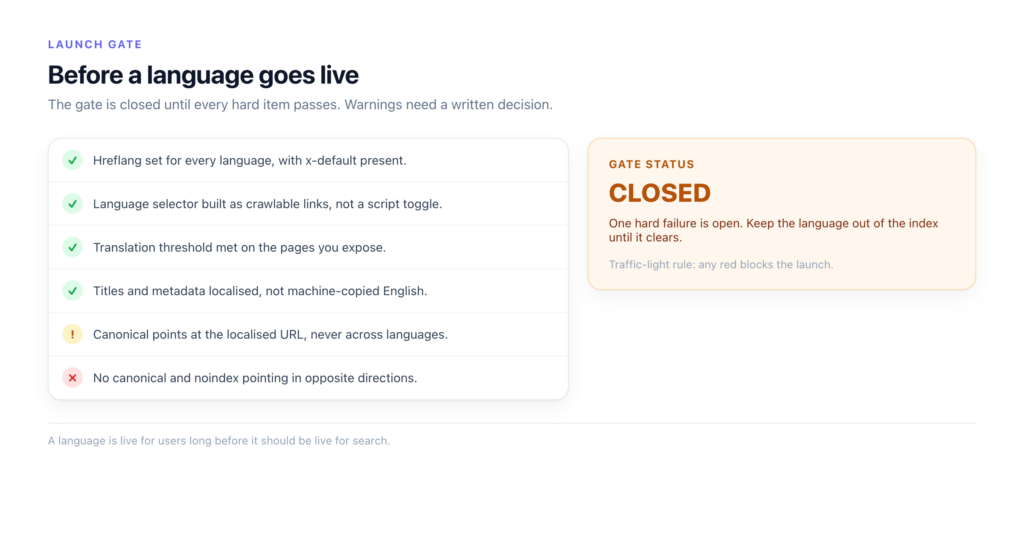
A launch gate is not complicated. It is a checklist enforced before a language is exposed to search. Here is what we check.
Hreflang and x-default. Every page in the new language must have correct bidirectional hreflang annotations. The x-default page must exist and must point to a language selector or the canonical home page. No orphaned hreflang entries. No self-referencing errors. We validate this with a script that crawls a representative sample and checks every alternate link.
A crawlable language selector. A search engine needs a way to discover the new language. That means a visible, linkable language switcher on every page. Not a JavaScript dropdown that loads on click. A real anchor element with a real href attribute. The selector itself should sit on the x-default page so crawlers find it from any language entry point.
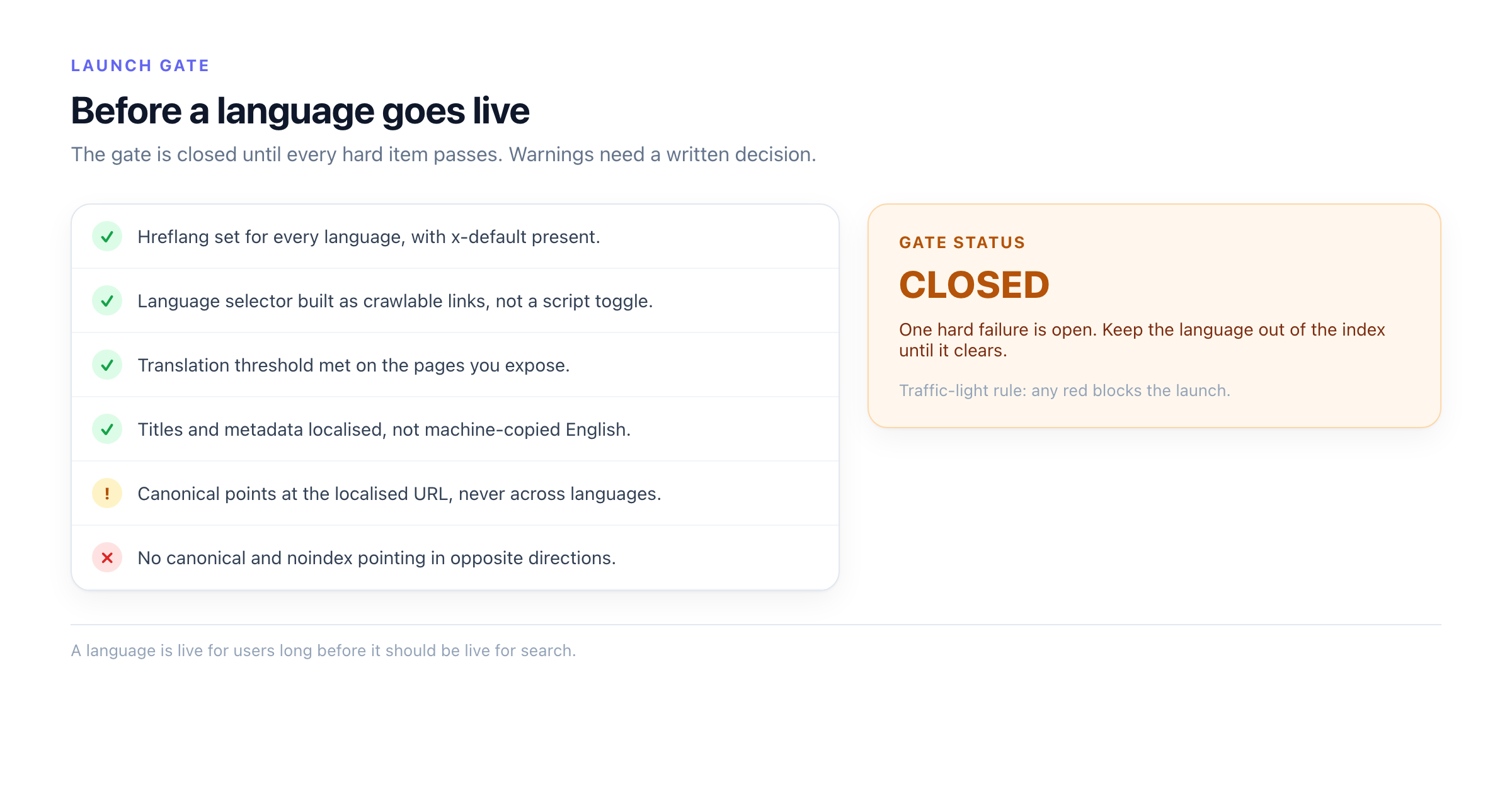
A partial translation threshold. We do not require 100 percent translation to open a language. That would block progress forever on long tail content. But we do require a minimum. The homepage, the top five categories, the about page, the contact page, and the site wide navigation must be fully translated. Everything else can follow. The threshold ensures that when a crawler lands on the language root, it sees a coherent experience. Not a mix of German headers with English product descriptions.
Localised titles and metadata. The page title and the meta description must be in the target language. This sounds obvious, but I have seen sites serve English titles under /de/ for weeks. The title is a strong relevance signal. An English title on a German URL tells the search engine the page is not really for German users. We check every template variable for the new locale and confirm it is populated, not falling back to the default language.
4. Staging the Rollout
The new language must be kept out of the index until it clears the gate. The simplest way is a noindex on the entire language path during development. Every URL under /de/ gets a noindex directive. The page stays crawlable. A crawler can see it and validate the hreflang and the language selector. But it will not appear in search results.
We keep the noindex in place while the translation team works through the threshold list. While the QA team validates the hreflang. While the engineering team confirms the canonical tags are correct. Only when every item on the checklist passes do we remove the noindex and let search engines index the language.
This staged approach has a side benefit. The crawler sees the pages before they are indexed. It builds a map of the language. It sees the structure. It validates the signals. When the noindex comes off, indexing is fast. The pages do not need a fresh discovery cycle. They are already in the crawl queue. They just needed the green light.
5. Monitoring After Launch
The first few weeks after a language launch are the most fragile. I watch three things closely.
Index coverage by language. Search Console shows the number of indexed pages per language. I expect a steady climb after the noindex is removed. If the count flatlines or drops, something is wrong. Usually it is a blocked resource, a JavaScript dependency, or a server error that only affects the new locale.
Hreflang impression split. I compare the impression share across languages for the same set of URLs. If the new language is getting impressions for English queries, the hreflang is not working. The pages are being served to the wrong audience.
Crawl error rate by locale. A new language often introduces new URL patterns. If those patterns produce 404 or 500 responses, the crawl budget burns on errors. I set up a dashboard alert for any locale whose error rate exceeds the site average.
The monitoring phase is also when we validate the translation quality signal. If the bounce rate for the new language is significantly higher than the English equivalent, the content may not be good enough yet. The gate covered structural readiness. It cannot cover content quality. That is a separate loop, but we track it from day one.
6. When the Problem Came Back
A gate is not a one time fix. It has to be maintained. I learned this the hard way.
Six months after we launched German, I noticed a subset of pages showing the canonical plus noindex conflict again. The gate had caught it before launch. We fixed it. We moved on. But a new developer on the team added a feature that injected a canonical tag into all pages. The template already had a conditional noindex for untranslated content. The two tags met in production and produced the same contradiction we had fixed at launch.
Nobody noticed because the gate was only applied at launch time. There was no ongoing check. The regression lived in the index for three weeks before I caught it in a routine audit.
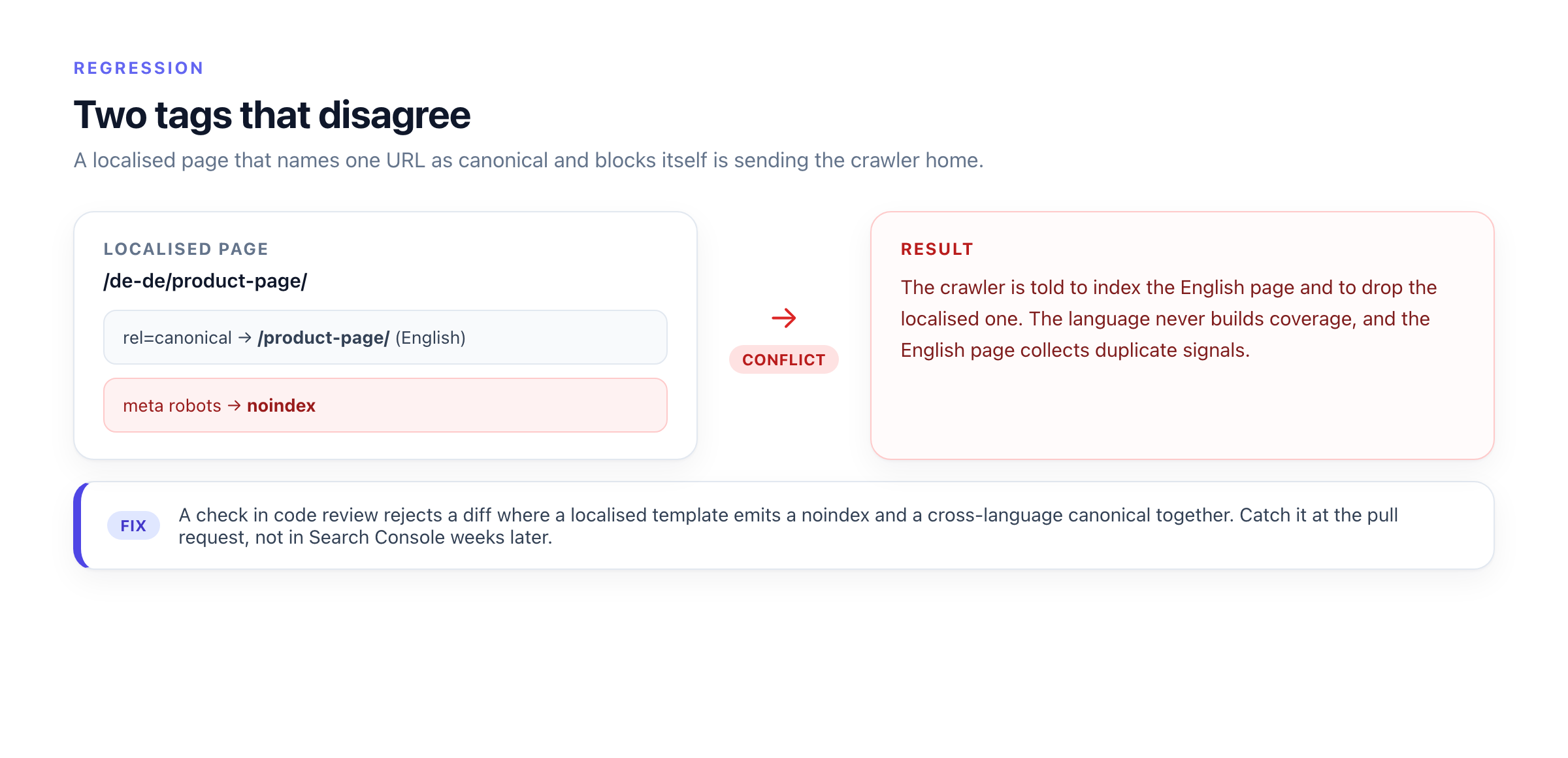
The fix was not a new gate. It was a code review rule. Every pull request that touches the head section of any page template must include a check for canonical and noindex coexistence. If both tags are present on the same page, the review fails. It is a simple assertion. It costs nothing to run. And it prevents the regression from ever reaching production again.
This is the real value of a gate. It is not a document that sits in a wiki. It is a set of automated checks that run every time someone changes the code. The launch gate catches the first occurrence. The code review rule catches every repeat.
7. The Checklist
Here is the full gate checklist. Apply it before any language goes live and verify each item with an automated test or a manual QA pass.
- Hreflang annotations are bidirectional and correct for every page in the target set.
- An x-default page exists and links to the language selector.
- The language selector is a crawlable anchor element on every page.
- The homepage, top categories, about page, and contact page are fully translated.
- Every page title and meta description is in the target language, with no fallback to the default locale.
- The entire language path carries a noindex during development.
- The noindex is removed only after items 1 through 5 pass.
- A code review rule checks every template change for canonical and noindex conflicts.
- Monitoring dashboards are configured for index coverage, hreflang impression split, and crawl errors by locale.
A language launch is a release. It deserves the same discipline as a feature launch. The gate is the minimum bar. It does not guarantee success. But it guarantees that the site does not hurt itself the moment a new language goes live. That is a good start.